A tourist train route should do more than form a loop around the edge of an amusement park. The route should connect useful destinations, provide an enjoyable sightseeing experience and remain compatible with the physical limits of the selected train.
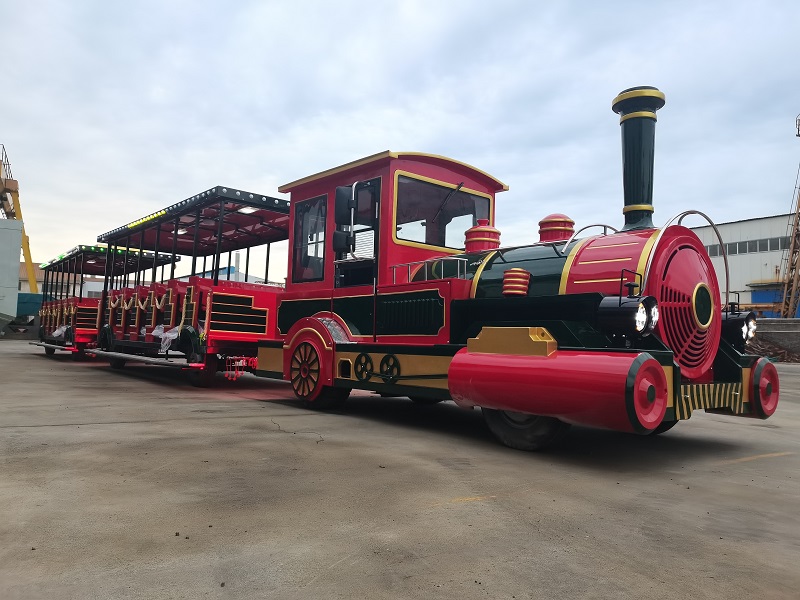
DINIS offers both trackless and track-mounted vintage trains with different capacities, lengths and turning requirements. The current product information lists trackless turning-radius references of 3 m, 6 m and 8 m for different size classes, while its track-mounted vintage trains use a separate route specification.
A vintage tourist train route-planning guide should therefore start with the actual train configuration.
Should You Choose a Trackless or Track Route First?
Yes, because this decision changes the entire planning method.
A trackless vintage train travels on the prepared park roadway, giving operators more flexibility to adjust the route later. A rail-based amusement train requires a dedicated track alignment and therefore needs more fixed infrastructure.
DINIS currently supplies both types within its vintage-train range.
If the park layout may change frequently, route flexibility can be important. If the train is intended as a permanent sightseeing attraction with a clearly defined circuit, a fixed-track concept may be considered.
How Important Is Turning Radius?
Turning radius is one of the first geometric checks that should be made.
The target page lists approximately 3 m, 6 m and 8 m turning-radius references for small, medium and large trackless vintage-train configurations respectively. The track-mounted configurations list a separate reference of at least 7 m.
The concept of turning radius describes how much space a vehicle needs to negotiate a turn.
For a park project, the designer should check every corner—not just the widest road on the route—against the confirmed technical drawing for the exact train.
Where Should Stations and Stops Be Located?
Stations should be placed where passengers actually need them.
Typical locations include the main entrance, family zones, large attraction clusters, food areas, resorts or distant sections that would otherwise require a long walk.
A useful real project reference is the UK scenic-area vintage train route-planning case. DINIS reports that its engineers first planned the route for an approximately 100,000 m² scenic area and then laid roughly 800 m of track through major attractions.
This illustrates an important principle: the route should serve visitor destinations instead of following an arbitrary geometric loop.
How Should the Route Interact With Pedestrians?
Pedestrian interaction needs careful attention, especially in busy family parks.
Avoid placing the train through the most congested queue areas when an alternative alignment is available. Crossings should be easy for both drivers and pedestrians to understand, and boarding areas should not block normal visitor circulation.
For a trackless train, road width and turning requirements must be reviewed together. For a track train, the fixed alignment also needs to fit entrances, pathways and surrounding attractions.
A retro amusement train circulation-layout plan should therefore be developed together with the park’s pedestrian-flow plan, not after the other attractions have already been fixed.
What About Slopes, Scenery and Passenger Experience?
The route should combine technical feasibility with sightseeing value.
The vintage-train page lists model-specific slope references for track-mounted configurations and notes that some larger sightseeing arrangements may operate along lakes, rivers or other park landscapes depending on the project.
A train route can therefore connect functional destinations while also passing attractive scenery, themed areas or landmark rides.
However, scenery should never override the train’s confirmed gradient, turning and roadway requirements. The final route needs to satisfy both visitor experience and technical operation.
What Information Should Be Prepared Before Route Design?
Prepare a scaled park map showing roads, attraction locations, pedestrian areas, slopes, proposed stations and any restricted zones.
Also provide expected passenger demand and the intended train capacity. A 16-20-seat train and a 40+ passenger train do not occupy the route in the same way. DINIS’s published vintage-train configurations differ significantly in overall length and turning requirements.
The DINIS amusement train route-planning team can then evaluate the route against the selected train rather than recommending a path from the total park area alone.
The best route is one that connects important destinations, fits the train geometry and creates a pleasant sightseeing circuit.
Detailed vintage train information is available at https://www.dinistrains.com/vintage-amusement-park-trains-for-sale/
Leave a Reply